
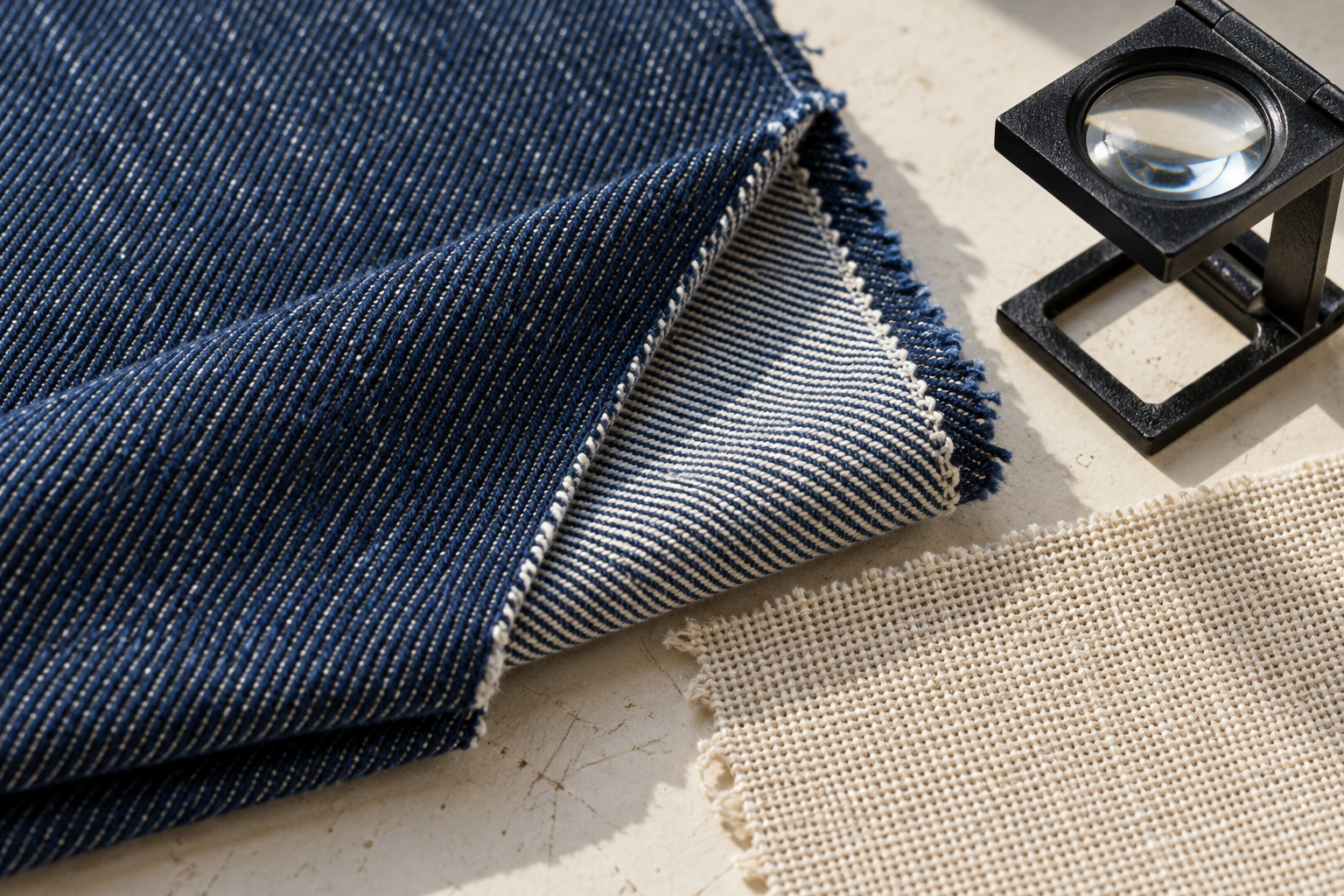
Twill is a woven construction recognized by a diagonal line in the yarn pattern. It is not a fiber and does not automatically mean cotton, denim, heavy fabric or superior durability. Read the fiber label separately, then use the surface and reverse of the fabric to understand its construction.
For a buying decision, “cotton twill” answers two questions: cotton identifies the fiber, while twill identifies the weave. Weight, finish, stretch, shrinkage and suitability still need their own information.
Look for the diagonal in the yarns
Under good light, follow a small section of the fabric rather than the printed design. Twill’s interlacing pattern shifts from row to row, producing the visible diagonal. Turn the fabric over and compare the yarn pattern on the reverse. A diagonal print or brushed surface can imitate a visual line without identifying the actual weave.
CottonWorks describes left- and right-hand twills according to the direction of the diagonal. Its 2/1 example shows a warp yarn floating over two weft yarns and under one in the repeat. That notation describes interlacing, not ounces, GSM or fiber percentages. Confirm which face and yarn system a supplier’s notation describes.
Twill, plain weave and sateen answer different visual questions
| Construction | What to look for | What it does not establish |
|---|---|---|
| Plain weave | Frequent alternating warp/weft intersections, often a grid-like appearance | A particular weight or lack of finishing |
| Twill | A diagonal progression in the interlacings | Cotton content or a universal strength advantage |
| Satin/sateen family | Longer floats with interlacings arranged without a continuous twill line | Silk fiber, a guaranteed sheen or a fixed performance level |
In cotton goods, sateen usually describes a filling-faced satin construction. It should not be confused with “satin” used loosely as a marketing description of a smooth surface. Use the percale and sateen comparison for bedding choices; this page identifies the broader weave geometry.
Why denim is an example rather than a definition
Many denim fabrics use twill, which makes the familiar diagonal a useful starting point. Denim has additional yarn, color and finishing characteristics; it is not a synonym for every twill. A light trouser fabric, a workwear cloth and a decorative textile can all use twill while behaving differently.
For denim-specific construction and buying questions, use the cotton denim guide. Do not infer stretch from a twill label. Ask for the fiber blend and test the intended product: elastane, yarn geometry and finishing can change how it moves and recovers.
Compare the exact cloth for its job
A diagonal does not tell you whether a trouser knee will wear through, a seam will distort or a curtain will hang as intended. Look at weight, yarn, density, finish and care together. Longer surface floats can affect the feel and exposure of yarns, but wear performance needs evidence for the actual fabric and use.
For clothing, inspect opacity and movement under realistic conditions. For interiors, compare drape and appearance at the intended scale. A small swatch can conceal a directional pattern that becomes obvious across a large panel or at a seam. Record the fabric face and cutting direction when consistent appearance matters.
Ask for a specification beyond “twill”
- Fiber names and percentages, including any elastic component.
- Weave description and the intended face.
- Finished fabric weight and usable width.
- Color and finish reference, with permitted variation.
- Care instructions and relevant dimensional-change evidence.
- Performance results for the actual risk, such as abrasion, tear or seam behavior.
A higher GSM or a denser-looking diagonal does not settle those points. The GSM guide helps compare mass per area while keeping it separate from quality.
Care follows the product, not the weave name
Follow the sewn care label for the finished item. Lining, dye, trims, finish and blends can make the care needs of two twills different. Try an inconspicuous care test only where the product instructions allow it; do not use a universal hot wash or ironing setting because the cloth looks like cotton.
If a seller cannot explain the fiber content or construction, treat the missing information as unresolved. Twill is a useful way to describe how yarns cross, not a complete promise of how a product will perform.
Next steps
Distinguish woven and knitted fabrics · Compare fabric weight · Assess cotton quality
How this guide was prepared
Desk research of public technical guidance and the identified product descriptions. No product testing, installation, supplier audit or site visit is claimed.
Sources and scope
- CottonWorks — Basic woven fabric designs
Diagonal twill lines, over/under notation and comparison with satin construction.
Accessed 2026-11-02 - CottonWorks — Weaving basics
Warp/weft interlacing and the basic weave families.
Accessed 2026-11-02 - FTC — Textile labeling guidance
Fiber disclosure is separate from a fabric-construction name.
Accessed 2026-11-02
Questions & discussion
Share a question or a useful experience about this guide. Comments appear immediately. Your name and comment are public. Email is optional and stays private; reply emails are not enabled yet. Comment privacy.